Discovering the Pacific Ocean on a Freighter, 2005
It was 4:30 in the morning on a Thursday (September 29, 2005, to be exact) when we woke to the realization that we were moving. All the years of talking about going round the world for a year, the past month of driving from coast to coast to bring us to our point of embarkation, all the emails with our broker and the post office drops to exchange paperwork has brought us to this point.
“We’re moving, we’re moving!!” It doesn’t matter that we’ve only had about four hours of sleep … we are more excited than eight-year-olds on Christmas Eve. This is a heady cocktail and we are filled with anticipation and apprehension. What on Earth are we getting ourselves into, we laugh. Then we laugh more because we realize how fortunate we are to share this desire to experience the world and to both be crazy enough to kneel on a hard bed at 4:30 in the morning because we will admit to being excited about floating off into the darkness. This is a big moment for us, as it will be a year before we return stateside. We force ourselves to go back to sleep, as breakfast is at 7:30 a.m. and we need to get into a schedule.
Accommodations in the Owners Cabin are spacious
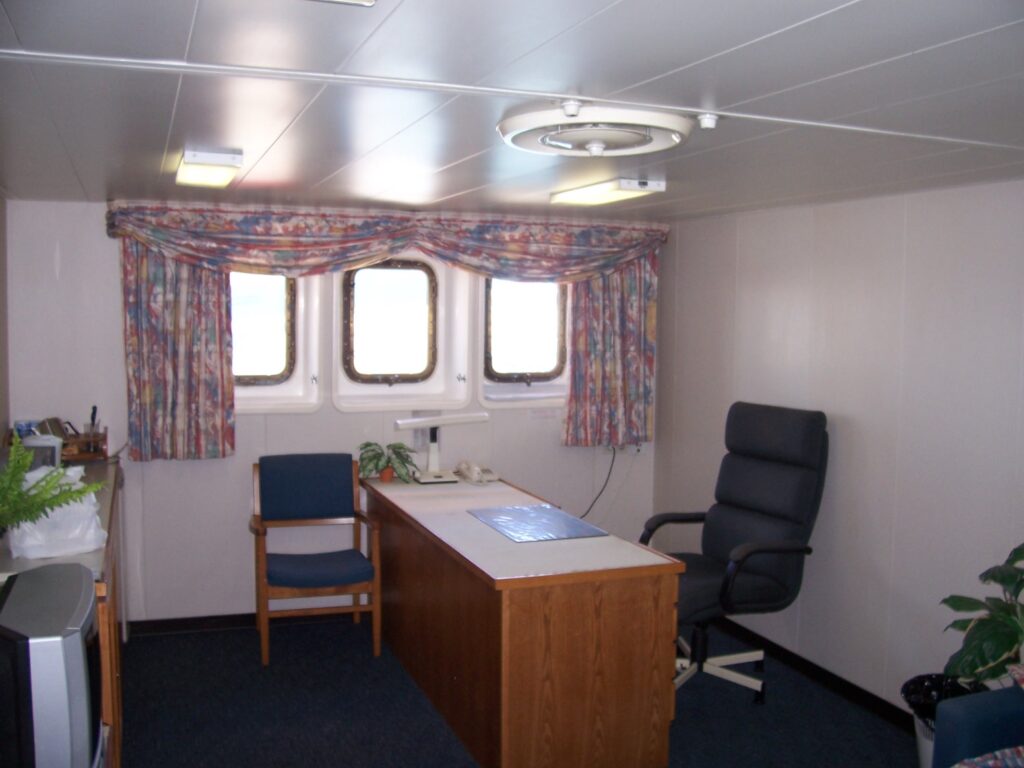
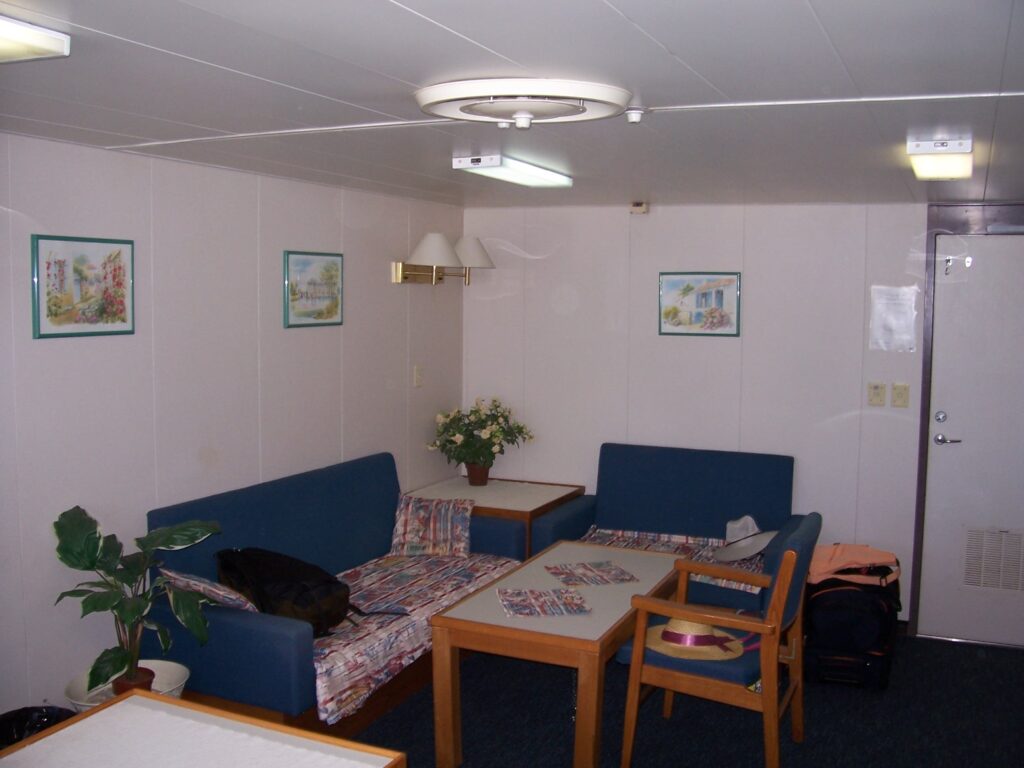
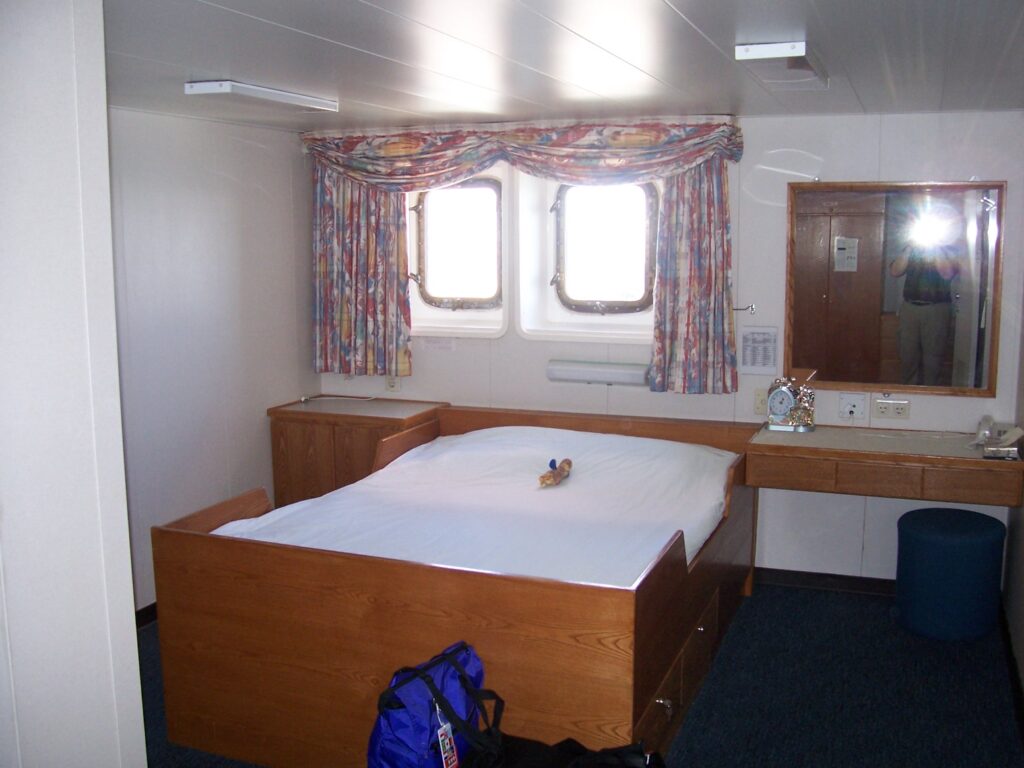
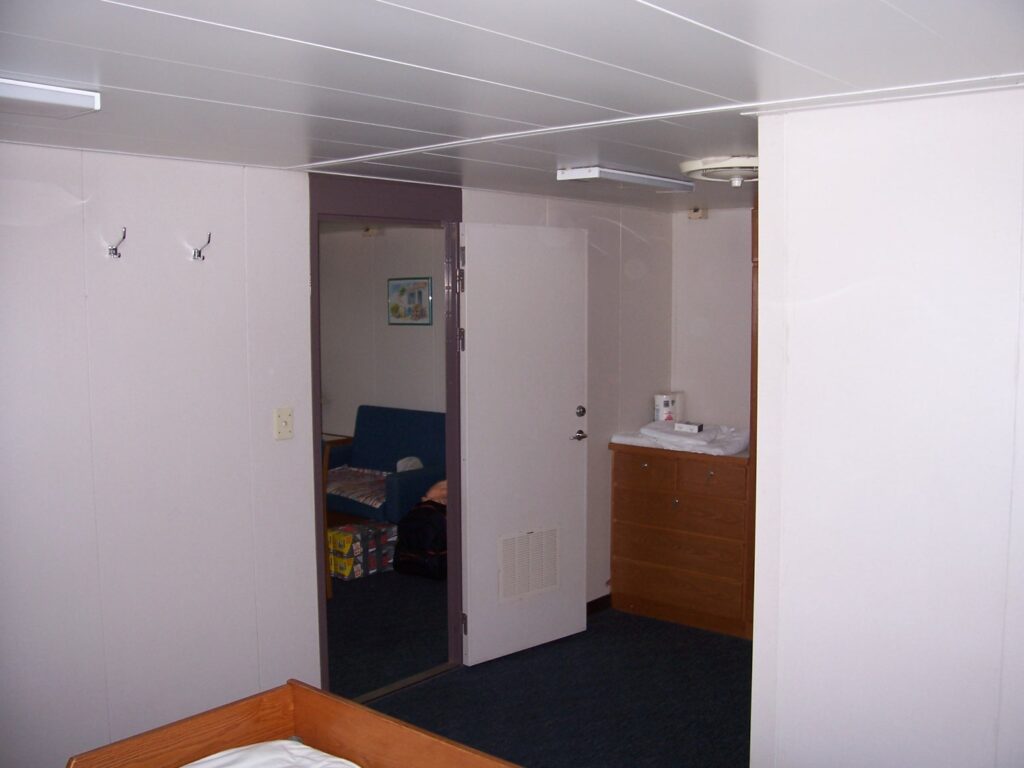
Our cabin is the “Owners Cabin” located just one level down from the bridge. The Captain has a suite on one side and the Chief has his on the other. Our suite has a large sitting area as well as a desk and credenza; a separate room for the bed and bathroom.
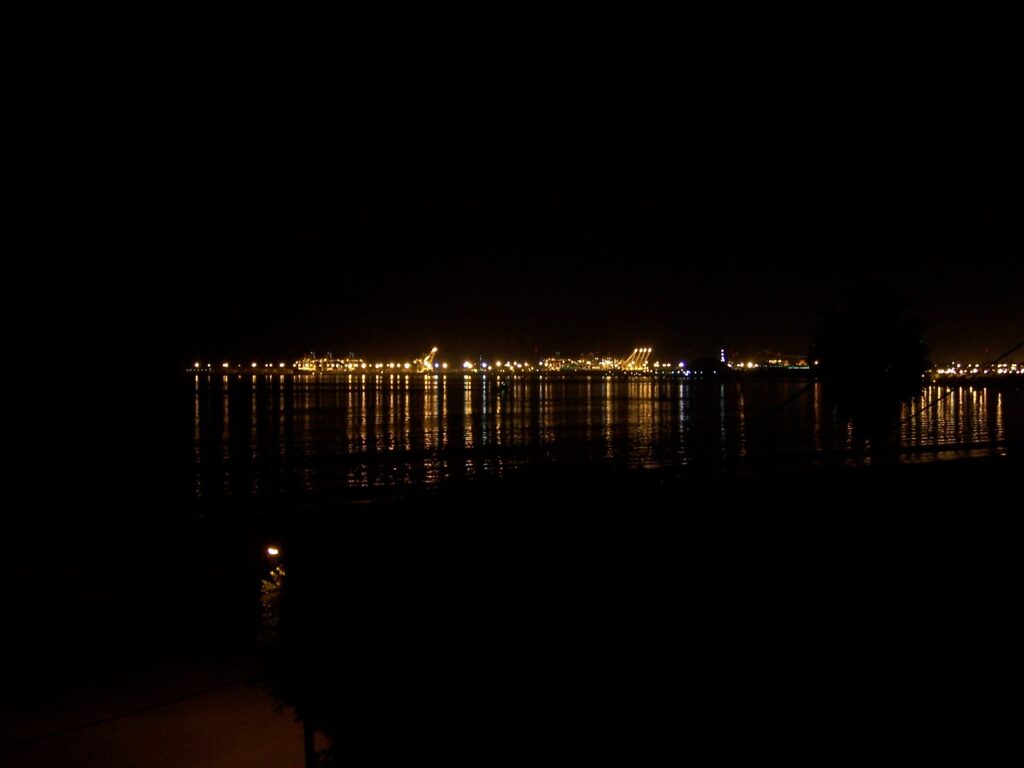
The bed is a killer. It is, as one expects, a box sort of affair with a mattress. This helps, I’m sure, to keep the mattress on the bed but it also means there is not much cushion. Rio said it was a brand new mattress and it has the rigidity of one! Being a side sleeper, my hip bones were very sore at first. Actually, we both woke the first morning with sore knees from kneeling on the bed to look down into the hold as they loaded containers in Long Beach.
The hard mattress is not getting any softer. After a rough first night, we found a wool blanket and put it under the sheet, folded over to add two layers below our butts. We fall asleep but wake up as we roll over and hips and shoulders hurt. Two mornings later we flipped the mattress and refolded the blanket to be four thicknesses and then put it at butt level. Either we got used to being sore or that worked as eventually we could sleep peacefully.
Mealtime schedules coincide with officer duty hours
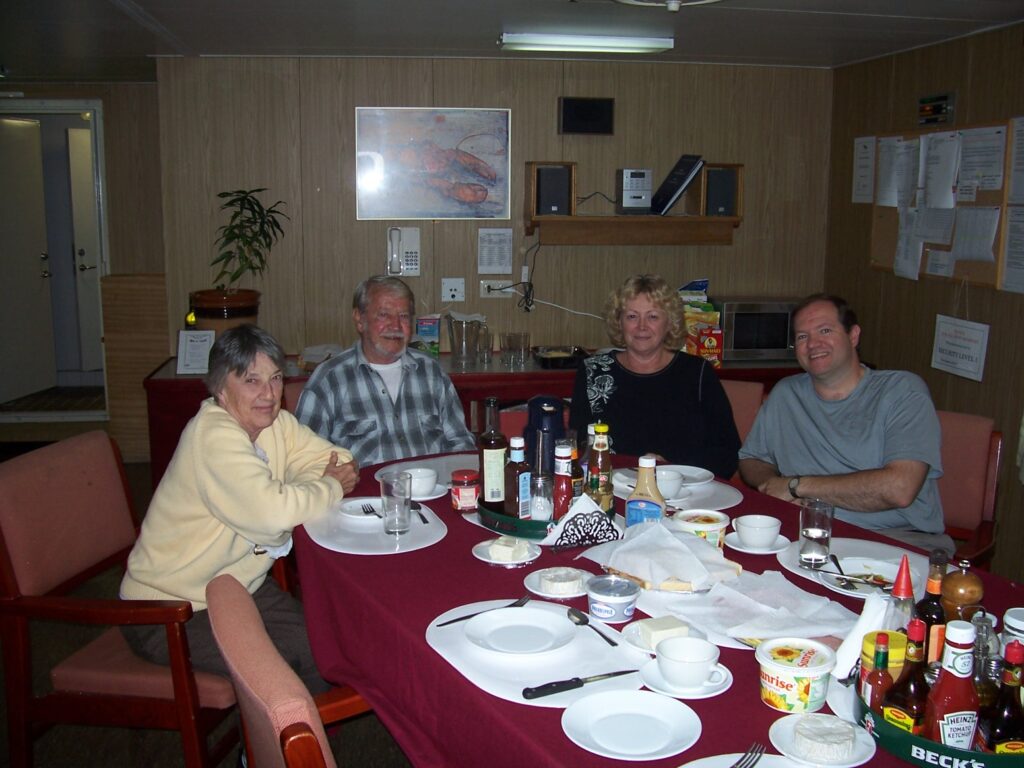
As we learned upon embarking in Long Beach, meals are served at set hours: breakfast, 7:30-8:30; lunch, 11:30-12:30; and dinner, 5:30-6:30. The Captain and his chiefs sit at a round table a few feet from our larger, rectangular table that can seat eight – four junior officers and four passengers – although it turns out our table is rarely at full capacity.
It is standard practice to have officers work two four-hour shifts each day: either 12-4, 4-8 or 8-12 with the most senior officer getting the best hours, followed by the more junior (the Seconds and the Thirds). This means that if you have the 12-4 shift, you work from midnight to 4:00 a.m. and from noon to 4:00 p.m. every day.
This may seem odd to all of us 9-5 types, but it makes a lot of sense on a ship. It keeps everyone fresh and, after all, they have no place to go anyway. Not being dullards, we put the two thoughts together and realized that the galley schedule facilitates feeding those men who are going on duty as well as those coming off. It was not unusual to see one man get up and leave and another show up mid-stream. The Captain does not work one of these shifts – the Captain is always available, 24/7, to manage the ship and everything and everyone on board.
Only four passengers on board the “CP Tui”
We met our fellow passengers last night at dinner – Joan got on in Long Beach sometime after we did and is a retired Californian who will be debarking in Australia. Dave is a New Zealander, on his way home after being on the Tui for a month already. He originally boarded in New Zealand and took the tour up to Tahiti and then Vancouver before coming south to Long Beach where we all boarded.
Our first breakfast is French toast and eggs to order. Joan’s request for maple syrup is met with a worried look – no, never heard of maple syrup although there is butter and numerous other condiments all corralled into high-lipped trays at either end of our table. We also have a carafe of coffee and, on the sideboard, there is milk and juice, glasses, and cereals as well as a microwave in case anyone wishes to heat up something or make oatmeal. We quickly learn that each day’s menu is written out and placed on the sideboard in the morning so we can give it a check-over as we enter and get our requests in line for when Rio comes to see what we want.
Rio, from the Philippines, is the Ship Steward. A pleasant, hard working and capable young man, one of his jobs is to assist the Cook, serve prepared foods and bus tables. He always shows up within a minute of any of us entering the galley, to ask what we want or to see if we’ll take what is on the menu for a given meal. This isn’t a multiple choice event, but when eggs are on the menu for breakfast, they come “made to order” and if you hate peas, for instance, and peas are the vegetable for a meal, you can ask him to not put them on your plate.
Rio, the Ship’s Steward, has a multifaceted job
Rio, it turns out, begins each day at 4:30 a.m. In addition to watching over all of us at breakfast, lunch and dinner, he arrives at our cabin every morning at 9:00 to remove any trash; he exchanges linens every five days or so as well as doing the laundry for that linen; and vacuums the cabins every three days or so.
He is also in charge of delivering the Captain’s slop chest items, has a role to play in emergency evacuation situations and plays ping pong at night “for exercise.” Slop chest, by the way, is a term used for the items the Captain purchases for sale to crew and passengers. The supplies are very limited, but generally there will be a toothbrush, toothpaste, water, beer, spirits, cigarettes and a couple of types of candy bars.
Our Captain has inherited some supplies from his predecessor and retains that Captain’s pricing structure for those items while charging only cost for anything he has purchased. He simply does not believe he needs to make pocket money from the sale of such items to his own crew and passengers and we like him even more for that attitude.
On the days that the slop chest is “open,” there are order slips on the sideboard in the dining room and we are welcome to fill one out to order from the sheet of available items. Rio brings the orders to the Captain and then, after dinner that night, delivers the goods to your cabin. Sometime before debarking, the Captain contacts each passenger with a total amount due and you pay in cash – American dollars. We bought a carton of bottled water for brushing teeth and drinking and ended up sharing with Joan as they were two liter bottles and more than we needed. It worked out well, as she didn’t need a whole carton either!
Lunch is a hardy meal followed by a walk about
Lunch the first day was a pork chop with a fried egg on top, potato croquettes and canned asparagus – oh, and chicken macaroni soup before and three slices of honeydew melon after. Since the galley is closer to deck, I asked Rob to shepherd the ladies around the ship before we would climb back to our rooms.
The water is an incredibly intense and quite beautiful deep blue but we are each very, very careful to grab hold of things here and there – no one is leaning over, for sure. Water is hard to describe because it has a depth color – the base, as it were – and then the top which is glasslike in reflecting the sun and light and cloud shadows. It is that glassy top layer that shimmers and quakes but out here in the depths, you really get the full force of the deep navy blue beneath.
The froth kicked up by the prow makes turquoise and white lace trim along the nearside that ends up as a wide wake behind – our footprint across the ocean. I longed to be able to record the deep blue on film, but know that will not really happen as the glitter mirror-top protects that view.
Rob had a spot of upset with headache, after breakfast, so it was a good thing to go eat and then walk about outside. The fresh air and keeping the horizon in sight does its wonders. After clambering back in, we both thought a nap would be good, so we slept for a couple of hours. Dinner will be spaghetti. As it heads toward 4:00 p.m., we are going directly into the sun. The seas are a bit friskier here, which is what woke us up.
Getting used to being a speck on the Pacific
We are heading SSW in a straight line from Long Beach to Auckland. The afternoon sun is blinding as it shimmers across the ripples. Day one and we have already learned that the sun on the ocean is something else. To port (yes, that is the left side as you face forward), the water appears as it did earlier – dark, dark blue with little rolling swells here and there – no whitecaps other than the lacy froth we create as we glide along.
To starboard, however, the sun creates the illusion of choppy waters as it gives dimension in light and shadows to each wave. Earlier today, it was clear for miles – nothing but water; now we are heading for a veil of foggy white mist. Suddenly we can see little puffy clouds beginning to go overhead and wonder if the mist wasn’t just that – a patch of clouds that seemed to sit at the ocean’s edge until we reached them.
The art of time zones on a working ship
There is so much to learn about ship life. For example, at lunch we learned that all the ship’s clocks are electronic and will automatically be reset as we pass through time zones. I wondered if they don’t cheat a bit and force it during the night or something…it sure would play havoc with scheduling to have it mid-workday.
We wonder how everything works and we – who have always thought we had a modicum of control over our lives – realize we are truly out of control here, where we must rely on the Captain and his crew for everything. This is not a Disney ride that will end in a minute or two; we are heading straight for the sun, and there is no turning back.
When we woke on the first of October it was a new time zone. That made breakfast seem to come at a more reasonable hour since we gained an hour in the night. My guess proved correct, too. They do the clock turning at midnight so the third officer gets the extra hour to work.
BBQ Night with Karaoke
In the seemingly middle of the Pacific Ocean, with water all around us, there is a charcoal grill out at the furthest point aft beyond the muster station. Some 20 people from 5 countries share a Karaoke machine, a bottle of rum, another of vodka, a few beers, lots of sodas and grilled chicken and pork, along with a tossed green salad, potato salad and enough cake for all. It looks like the 4th of July in the middle of America!
The crew stand around a high “table” made up of a sheet of something draped over a steel thing and the officers and passengers sit at a picnic table on benches brought out from somewhere – all gently swaying to the swells as we go full-steam ahead. What fun. Oh, and Dave was the happiest of the lot since the meds I gave him earlier in the day worked; and he is feeling 100 percent. I’m so glad we had a full contingent of meds to share.
After the sun set, we started to walk back into the tower, but the walkway is totally black. It is scary at night because you can hear the water being tossed back into the ocean from the sides of the ship, but you can’t see anything. It is a toss-up whether you are more scared of falling overboard (sure death at night) or of falling and hitting your head (everything is solid steel, so that outcome doesn’t have a good part either). This was especially hard for me because I have night blindness. It was extremely hard for me to discern even shapes on this moonless night so I was happy to see them put out a light to help us find the tower again.
It was fun to join in the Saturday night break, but we feel a bit like interlopers who have been granted the favor of being able to share a smile with these hardworking men who leave family and friends behind for months at a time. They graciously do not begrudge our presence although we are slug-a-beds compared to them. They work every day to keep the ocean from eroding the ship and to keep the ship running. This is a good crew.
We meet Rio at b-fast and he says he was up until 1:00 a.m., cleaning up after the BBQ. All passengers show up for breakfast, but not many officers – none of the lower ranked ones who usually sit with us – just the Chief. Dave has arranged for us to get a tour of the engine room at 10:30. He did some sailing in his early days and is much more familiar with the operation of the ship and its crew and he is helping us along nicely.
The engine room tour includes work gloves
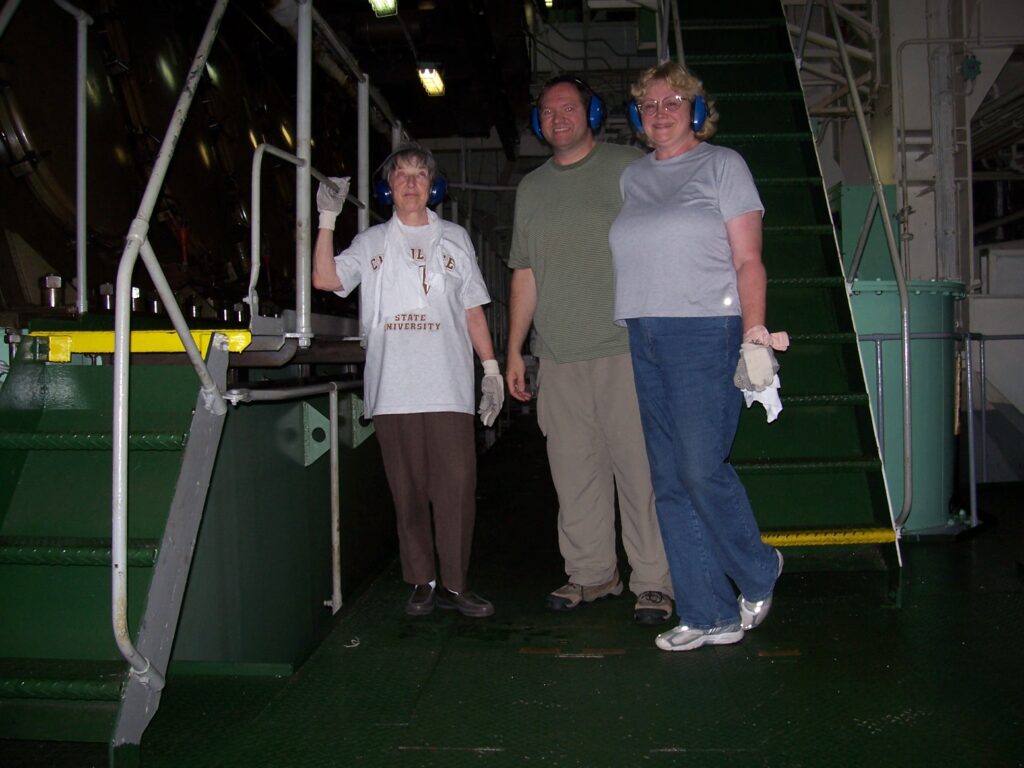
Well…we got our tour of the Engine Room. What a trip. The second (or is it third) engineer showed us how the ship has reclamation facilities to remove and purify water from waste so they can dump the fluid back into the ocean; and they distill sea water for drinking water (there is a tap in the crew’s mess) and for washing and cooking purposes. We also saw the air intake and the giant pistons and all that mechanical “stuff;” the parts that keep the ship moving.
It is very hot and very loud down in the engine room. We put on ear protectors and were given a pair of cotton work gloves so we could hold onto handrails and not get all greasy. Those gloves will come in handy on our walks around the decks, too. The hub of the engine room is very basic steel with a lot of dials and gauges and computer monitors.
Invitation to the bridge
One day we went up to the bridge to have a look around. Although this is only one flight up from our room, the view from here is fabulous. No portals here; the entire front wall from waist up is glass and the room is quite long – the full width of the tower minus two small decks, one port and another starboard. Just like the starship “Enterprise,” there are overstuffed arm chairs for the Captain and the officer on duty. We are free to use the binoculars that are set along the edge, just so long as we don’t mess with them – they are set for viewing.
The enormity of the ocean hits again. The view is awesome – turn to the left and slowly turn front and then to the right and all you see is bits of ship, water and horizon, some 20-30 miles away. Oh, and sky. Lots and lots of sky. You are always aware that you are just a dot, floating along…always moving, always humming with vibrations under your feet…sometimes rolling leisurely maybe five degrees to port and then to starboard.
There is a poster with pictures of the ocean that shows how to determine the wind speed based on the surface of the ocean; i.e., as the number of whitecaps increase, so does the wind. This is important, as the speed of the ship depends on the winds and waves. Another poster has pictures and descriptions of clouds. We check out the maps charting our path and laugh because there is an absolutely straight line drawn from Long Beach toward Auckland and we know we’ve been going straight ahead for days.
Rio says the seas from New Zealand to Australia are white – meaning, heavy with whitecaps and lots of rock, roll and pitch. We picked the right direction to go for this maiden voyage. Dave says the trip up was very rough, with two foot of water on the aft deck where we had our BBQ. Rio says the couple who were in our room on the way up never ate for three days, the seas were so rough.
We are very fortunate, indeed. As we hear this, it is our fifth day, one-third of the way across to New Zealand, about a day away from the Equator and, although it is getting warmer, it still is very calm. The days are always sun laden but the heat at night is new and the real indicator that we are getting nearer to the Equator.
So far we have not seen stars. Each day, around three o’clock, the sun starts to glare off the ocean at about the one o’clock position, just off starboard, and it lights up the waves. This is blinding to look at directly.
Unfortunately, by four o’clock, we seem to reach the horizon where before the clouds had been forming and there really isn’t much sky to see at night. Besides, they don’t want us walking about at night even if we had the nerve to wander, which we don’t. It is so incredibly dark and dangerous for us land lovers; eerie on these moonless nights.
Still surrounded by water, the heat of the day says we are nearing the Equator
I told the Captain one day that I was looking forward to seeing the Southern Cross – the southern hemisphere’s version of our Big Dipper constellation. He said it would be better as we near New Zealand. Even though we have been to Venezuela and Peru on prior trips, we were either too close to the equator or not out in the dark in a place to see it well before.
It has always been comforting to look up and see the Big Dipper as we travel to Europe; realizing our folks are under the same sky even though we know we aren’t really looking at it at the same time. There is constancy to the sight, even when surrounded by the strange and alien sights and smells of another land. So we are anxious to see the Southern Cross; to see what it is that provides that constancy for all the Down Under types.
We watched the stars for a long time one night. We even went outside, up on our F Deck level. The winds were so ferocious when we tried to look out over the front of the ship that we moved around back (the outside “deck” at this level is sort of L-shaped and just a few feet wide at the side, maybe 10’ x 12’ toward the back). Neither of us, even once, removed both hands at the same time from a handrail or a step or anything we could grab. The winds had to be at least 30 mph.
Rob was the first to notice the stars; from the living area he could see one star that was so bright he thought it was a plane or a satellite. We quickly turned off the room lights and, as our eyes began to adjust, thousands of stars popped into view – the bright primary ones and then the secondary and then the tertiary ones that our city lights hide – the Milky Way is there, in its splendor. What a present.
The ship is so scary at night – pitch black all around, but you hear the waves lap up as the prow cuts a swath across the Pacific. We don’t venture far; we are content with this spectacular sight.
Today, as we go into lunch, the Captain was speaking with Dave. There has been a terrible bus accident in Poland and some 20-30 children and a couple of teachers have died. His son had his backpack on and was ready to go climb on that bus when he suddenly said no, not today. How scary is that…to be so far away when you know your family could use a hug.”
– From our Journal Entry 010, October 4, 2005
Tonight we reflect on the day. The ocean was calm and we continued to move at a good clip, but the paradox is that we cannot arrive early; there is no room on the wharf for us so we need to “lose” two days. The Captain will slow us down or even stop to force our arrival to be on the 13th. Passenger Joan is chaffing at the bit to keep moving. It must be hard to do this voyage alone and we think she’s starting to have cabin fever, while Passenger Dave is happy as a clam because he loves being at sea.
During our morning walk around the ship we met Dave, who was intent on getting our stowaway starling to Auckland alive. As we spoke he suddenly pointed – three white birds flew across the bow without a look at us. From where they came, we have no clue! Christmas Island is out there somewhere, but a long way from us, for sure. No sign of our bird; he doesn’t come out to join the others.
It was dark as we woke today and the Captain’s alarm is what actually got us up in time for breakfast. Rob guesses correctly: they announced at breakfast that the time would be retarded another hour tonight. Oh, and at one in the morning, we are due to cross the Equator. We won’t be up to greet Neptune!
Wash day on the freighter is an adventure in itself
Life aboard a cargo freighter can be so boring and yet, so different. As passengers, it turns out we share a wash day with the Captain – Wednesdays and Saturdays. That means yesterday was wash day; our first, since we didn’t have anything to amount to much that first Saturday. Now we know better. The machine is very small and you are expected to pack it…no problem. We toss in half a scoop of non-suds soap that they provide, put another half scoop in the slot on top, close the door and press Start.
The problem arises if you watch the machine, as it seems very little water is in there and even fewer suds. We North American women are looking for lots of water and suds. We are doomed to be disappointed and tormented with worry. In the end, our suggestion to future travelers is to toss in the clothes, the allotted amount of soap, press Start and go back to your cabin for an hour…and no looking back!
Sure enough, an hour later, the wash is “done,” and we start to unload it only to discover it is sopping wet. Some items are wetter than others. Being contrary souls, we North American women are now concerned about that, as well. Again, the only recourse is to forget it – squeeze the excess water out into the slop tub and toss the clothes into the dryer and then return every hour to reset it, as nothing appears to dry.
Too many clothes, we decide, so we pull the whole lot out and start sorting things to put the quicker drying types together; return in 45 minutes to pull out the “done” things and add the next level; repeat all this too many times to discuss. At one point we bring a pile of clothes to the cabin and hang damp tops in every portal and clear off the desk to lay down socks in jigsaw puzzle fashion. By night we have walked up and down the stairs from F to D deck at least a dozen times and decide that most of our clothes are dry or will be by morning.
The red marks that appeared on my white pants as they came out of the washing machine eventually got washed out by hand. One of a pair of socks and a once white micro-fiber hair-dryer turban are now grey, and one of Rob’s shirts has drop marks along the shoulder as if spattered with bleach. The white pants dried with more wrinkles than one could imagine so they got folded up nice and tight and placed under everything in the drawer – the traveler’s best pressing method. On second thought, they might have done better under the mattress.
Dead in the water is a scary sensation
About halfway to Auckland, we sat in place nearly all day. At least this made the stair trekking easier. We will start moving around 10:00 p.m. because, for security purposes, they keep the ship moving at night. We have been told to expect to slow down again tomorrow as we still need to “lose” about 10 hours. The weather around New Zealand, apparently, is not so good, so it makes a lot of sense for us to sit here instead of to move closer and then stall in choppy seas as we wait for our previously booked arrival time.
Back to today, after b-fast we sat in the room a bit and decided to go walking. We stopped to see if Joan would like to join us…she does. The three of us go outside from her deck (E) and see Dave, who is sitting outside his door on D Deck, reading a book. He joins us for a bit on the bow; we stop to stare and gaze into the distance every so often as if there is something to see that wasn’t there yesterday and the day before. There isn’t. But wait – a bird flies by; one of those white ones. It never even thinks to fly over to us, for a rest on this floating island, but just keeps on flying.
Eventually we wound ourselves around to portside and clambered up the outside stairs to the bridge where we were granted permission to go in and gaze from that higher level – seven stories up. We look at the charts again: yes, we are below the Equator and see that we have passed Christmas Island too far to the west to be seen. The Officer on Duty says he is charting a course to put us close enough to Starbuck Island so that we will be able to see it – around noon. Our current course would put us at 15 miles east, so the change will let us drift a bit more westerly so we’ll be about 5 miles east.
We all get excited and run downstairs to our cabins to get refreshed so we can be at lunch right away at 11:30 a.m. so we’ll have plenty of time to eat. This is a good thing because the sun is baking us, 45 SPF or not. My hair was looking like Shirley Temple’s in this heat. For the first time ever, I woke every morning with a riot of curls: the waves have given over to the climate.
Lunch is good, again. A lot of people wondered what the food would be like so we feel the need to record our meals: asparagus soup followed by Chicken Fricassee, boiled potato, cauliflower and a side plate of sliced papaya. With the exception of the now famous broiled tuna that looked and acted like beef jerky, the food has been very good. Dave doesn’t show up right away and he hadn’t joined us on the bridge earlier, so Rob went to let him know about Starbuck Island. By 11:50, Joan was worried that if we didn’t run upstairs fast, we’d sail past the island and miss the whole thing. Did we mention the effects of cabin fever?
Land, land! Starbuck Island, Kiribati
No problem. Around noon, we go up and there it is – Starbuck Island – off the starboard bow to the west. We check the reference book – already old, as it was printed in 1982 by the Director of Hydrography – and it is 12 miles long and 15 feet (5 meters) at its highest point. There is a stone building or two, some vegetation and a black barrel to mark one of the two places you can land – if the winds are just right, as explained in the book.
At first, all we saw was a white line across the horizon that looked a lot like the spots we’d seen before when the sun broke through a set of clouds in the distance and made a spot on the ocean. Slowly we approach and more definition appears; the Officer on Duty shares the binoculars and, BOOM, we can clearly see the waves crashing over the north and south ends of the island, the tower which must be the stone building and a black spot.
It was that spot that brought us back to the book to read again about the safe landing spot. What amazes us the most? Hard to tell if it is the thought that anyone bothered to cart stone to this place and construct a building, or that a black barrel, placed in 1977, can still be sighted and hasn’t either eroded or simply been washed out to sea.
We all linger for some time; Dave and Rob making jokes about the inhabitants of the island – while we closed the gap and could see more clearly. Today this is a wildlife refuge under the Kiribati Government’s protection. None of us has heard of the Kiribati, but we’ll look it up when ashore. Apparently there is no fresh water, but there is some brackish stuff from guano diggers’ holes and portulaca plants abound.
Guano diggers; doesn’t that beat all? Someone came out here to pick up bird poop? Now that may be the most amazing thing of all. It must be very colorful when the portulaca bloom, but we cannot see that; we just see green and what appears to be one stand of trees – more than a dozen, a bit south of the mid-point.
This is sad, how excited we are to see this spit of land, and a testament to the fact we have been out here on this water for a full week. We see the little white birds flitting around and there was one larger bird earlier today. The large bird itself wasn’t too big but his wings were really quite long – enough to see the articulated wing structure like a bat’s: /\/\o/\/\ – he soared alongside, catching the ship’s draft.
Eventually we started drifting back westward to our course; we watch Starbuck Island recede before heading back to the room. Standing out on the top deck in the noonday sun is brutal. We need water and AC to recoup. After yesterday’s fiasco, we’ve decided to do some hand laundry every other day, so we take the time for that and to sort through some digital photos.
Cloud watching is something to do on a freighter
One evening, just SSW of Starbuck Island, I spent a good half hour watching the sun set while Rob was down in the conference room sorting through possible movie options with Dave and Joan. Not yet fully dark, I took a series of pictures, all the while wondering if I’d have the words to adequately describe what I just witnessed.
How elusive: a cloud, a sunset, viewed from a moving ship is a rapidly changing vision. Even now the bands of feathers overhead have suddenly turned pink bottomed; as the sun dips below the horizon, its rays now projecting up over the sky in front of us. No pun intended, but watercolors must be the medium to ever approximate this beauty. The deep navy blue water seems to be topped by flaming sprinkles of glitter.
At first, a random placement of small, spotty clouds stretching above the horizon, some six to seven miles from our forward looking portals. The sun at about one o’clock, to the right, was behind one of the biggest clouds in the sky, but still above the horizon. That cloud looked like a cat on a rug, holding a stuffed mouse toy between its front legs. It won’t show well in the photo, but the picture is snapped anyway because we need a way to at least activate the memory some other day. At 7:45, the sky is red-gray and stunning in its intensity.
The first thing that caught the eye was how the bottom line of the clouds seems to have been created by a thumb, swiping from left to right across the canvass, to create the sharp line of horizon and provide a misty space below flat-bottomed clouds. There are probably four or five small round clouds directly in front, moving like little tin soldiers to the right and the long-cat cloud. The clouds overhead are a flurry of feathers, dusted on for effect.
The ship chugs on…not fast as we are still marking time; maybe 10-15 knots (still novice guessers but after a week we feel we at least are confident enough to guess). The sun seems to move down as it is watched – now between the stuffed toy and the cat’s mouth. Suddenly the big cloud is a gigantic luminary as the sun becomes a bright orange bulb, backlighting the cloud that is the centerpiece of this stunning sunset. The colors are exactly like the ones on the Luminary Tulips at the New York Botanical Garden in May 2004.
Closer we charge and the colors change, cat is morphed into blob, but this does not diminish the view. It is a new painting now. No less beautiful for its change of composition.
The sun dips to the horizon and below and it is not long before the feathers of our night sky seem painted by a pink brush. Bands of water-painted pink feathers hover over dark deep navy shimmers. Twenty minutes from light grey to pink and then, BOOM: the sky is red.
The whole sky appears on fire with bands of red and grey with dark grey clouds floating in front for definition; seemingly strategically placed to give perspective to this meager human eye. The camera cannot record this although we try. Just as we try to write down what we saw, despite how the words fail to do it justice. It is moments like this that we can only hope to commit the sight to some storage cell in the brain to be available at some future day as a memory of a journey, once taken, unfolds.
An hour later we are in the Conference Room trying to watch “LA Confidential” on the TV (tape, of course). Romeo, the ship’s electrician wanted this picture instead of “The Full Monty” and we’d seen that anyway. It makes Dave laugh to realize the tough LA cop is Russell Crowe – a countryman of his. Now mesmerized by the rocking of the ship and the movie plot, the four passengers of the “CP Tui” smile as Romeo falls into a gentle sleep on the couch.
Another day, it seems, is over. As the Captain announced at dinner, “the clocks will be retarded one hour at midnight,” tomorrow will dawn under a different time zone as we march ever westward; but gently so, for in truth, our course is still SSW.
The Captain gave us a surprise today. We got Equatorial Baptism Certificates. It seems that Neptune gave us new names: Rob is now Flipper and Marilyn is Sea Nymph. Right!
10-11-05 (Tuesday) – We never got Monday, October 10!! Because the ship marked the crossing of the International Dateline at midnight, we skipped Monday entirely and went back another hour, all at midnight. This surely messes with your head.
10-13-05 (Thursday) – We are here…sitting outside the harbor at 4:30 a.m., waiting for the pilot to arrive and steer us in to Auckland, New Zealand. He isn’t expected until five o’clock and they don’t expect to start off-loading until seven or so, but we’ll go down for b-fast and then off with Dave. He has graciously offered to give us a thumb up or down about the location of whichever hotel we pick and to help Joan find a travel agent so she can make some arrangements for leaving Australia. We try to go back to sleep.
***
The phone ringing at seven o’clock wakes us up. The customs and immigration men are in the Conference Room across from the Officer’s Mess. We, of course, are not even dressed, much less packed, but we say we’ll be right there and toss on something fast, run a brush over our hairs and head down. So odd to have such personalized service – just as Dave and his process is a tad different since he is returning home after six weeks. Then again, he can’t be bringing in much, because these guys never stay long enough in any port to buy much!
We fill out the forms, the immigration fellow asks how long we intend to stay and we answer, a month. He gives us the standard three months allotted to tourists and we tell him that Dave has told us that, after seeing New Zealand, we’d soon tire of Australia and want to come back, so we might need that extra time. They laughed; they liked that one – quite a rivalry there, between the two countries.
__________________________
General Freighter Travel Issues . . .
Good health is a requirement for anyone interested in freighter travel. Freighter companies insist that potential passengers provide documentation attesting to their good health and ability to deal with known medical conditions as well as purchase evacuation insurance to cover the cost of being removed from a ship at sea. After all, these working vessels have no doctors on board and schedules to meet.
All application documents carry warnings about stairs and doors and being fit enough to travel. It is readily apparent why, soon after you check in to your new accommodations. Leaving the rocking and rolling motions aside, the tower stairs are steep and the steps themselves are narrow. Our first introduction was from A Deck – five flights up: yes, up six steps, three steps around, up six steps, three steps around, up six steps and repeat and repeat and … you get the idea. For us, we are grateful meals are on B deck and only four flights down and back up those three times a day. As to the doors, the stairwell doors have some form of hydraulic thing that keeps them shut – and makes them hard to open. Marilyn has to lean hard to open the door into the stairwell and then brace against the railing to pull it open when in the stairwell.
As to the issue of knees, understand that the prohibition against passengers who have had knee surgery is not an unfounded bias. Besides the steep step issue, the ship rocks gently, port to starboard, left to right, for most of the trip. At night, with our bed being parallel to the sides of the ship, it was like being in a cradle, the gentle rocking is soothing. On your feet, however, you soon learn (instinctively more than consciously) that you are most steady when facing fore or aft. The side-to-side rolling is absorbed by your knees playing shock absorber. If you stand facing the side of the ship, that same gentle roll forces you up on your toes and then heels and that is not an easy motion. Try it. Stand with your legs about shoulder width apart – lean gently left about 3-4 inches and then right 3-4 inches and repeat. Your legs compensate and, as you teeter-tauter back and forth, one knee bends while the other extends. Now try doing the same rolling motion but from front to back. Can’t do it without moving your feet; you tip over. This whole sensation didn’t really dawn on us until we got far enough south that we started moving more West and/or hit a different current about two days out of Auckland. All of a sudden the swells were running straight on at us and the ship started pitching instead of rolling: prow up, prow down – and we all were lurching around. We had to learn to turn our bodies 90 degrees; to face either side of the ship so we could go back to that gentle rocking motion.
The physical layout of the “CP Tui” must resemble most container ships, so the description should start below deck. The belly of the ship contains the engines and lots and lots of cargo all housed in cargo containers that look like boxcars and are made to fit on train carriers. These giant metal boxes we see on the “Tui” are called hi-cube containers: 40’ long and 9.5’ high, they each hold 58,000 pounds and have a tare weight of another 9,150 pounds. The ship’s holds are giant rectangular holes, just big enough to fit the length of a container and separated from port to starboard by vertical pieces of steel positioned precisely to form open slots into which the containers are positioned, one atop the other. The container port’s giant cranes pick a container up off a truck, swing it over the hold, and slowly lower it down between the slots; each box has corner pieces that allow the one on top to slot into the one below, etc. Sometimes two shorter containers appear; they neatly fit atop a 40’ one. In the hold immediately beneath our portals we watched last night as they lowered three open containers (solid platform and end pieces) at the top of three separate stacks, each holding one large camper trailer. We expect this inside storage place will afford some protection against the corrosive nature of sea salt.
When a hold is full – the one immediately below our tower holds eight wide and six deep – the cranes pick up the removable steel covers and swing them into place. It takes three pieces to cover the one hold immediately below us; guessing, we’d say they must be at least 40’ by 40’ and maybe 2’ thick. Once those are all set, they load cargo on top of what we land lovers used to think was “the deck” but now know is simply a canopy some 8’-10’ above the walkway around the sides of the ship. The crew quickly add metal braces that X-back and forth to hold the bottom level or two in place. Depending on how high a stack is directly in front of the tower, the containers may block any forward view for those living on the lower levels. As some of these are working refrigerated units, they can also be noisy if just outside your portal window. After the ship is loaded, anyone walking around the Upper Deck may think it is a covered walk, but if you look up you soon realize you are looking at the bottom of the end containers. A very unnerving feeling, that! The “Tui” carries 12 containers across, mid-ship, and we marvel that these ships float at all, given what must be the total weight which we cannot calculate.
The Tower is the large, solid structure you see on container ships that sits more aft than forward and is more building-like in appearance. That is because the tower houses the living quarters as well as general use areas such as the galley, conference and recreation rooms. It is topped by the enclosed bridge just under an open deck roof top. We are quartered in the Owner’s Cabin on F Deck; a two-room suite just under the bridge, mid-ship, flanked by the Captain on one side and the Chief Officer on the other. The inside tower stairwell, runs from A to F Deck, but across the hall from our door is an open inside stairway that leads to the bridge.
As you enter the suite, there is a sitting area with two couches and a coffee table; several coat hooks on the wall at the left before the door to the bedroom. Passing by that door is a sideboard with storage and a moderately large apartment-sized frig below a long counter; a plug-in pot to heat water and a basket of packaged teas and coffees and related condiments – all across from a long desk with an executive chair firmly bolted to the floor and a couple of typical office chairs for visitors. The furniture has the clear lines of Danish modern (how old is that, these days?); utilitarian, but utterly appropriate looking. Draperies with tie backs can be closed at night (we later learn that non-passenger ships cover windows at night to facilitate identification by other, passing ships – they all triangulate size and distance using the other ship’s running lights – so they close up portal windows to avoid confusing each other by having additional lights showing.
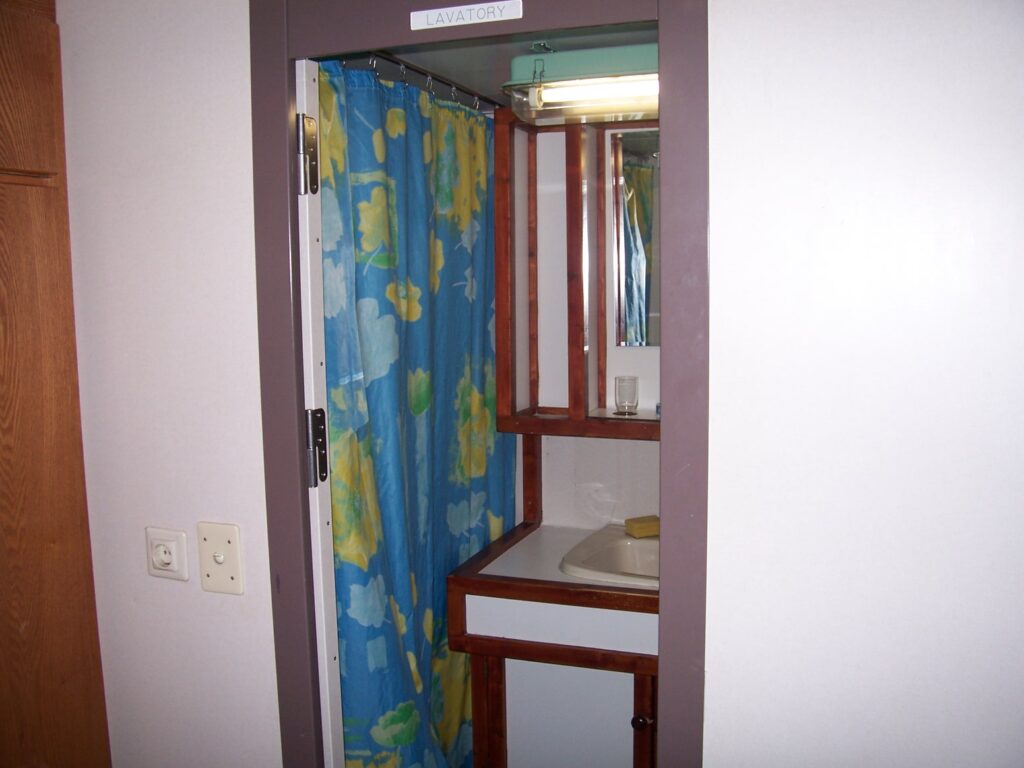
The adjoining room has a large closet and dresser at one end, a private bathroom and a box bed with nightstand. Did we mention yet how incredibly hard the bed is? It is incredibly hard. Marilyn has bruises on her knees from peering out to watch the container loading operation and sore hip bones from sleeping on her side too long. After a few days of experimenting with folding a blanket to put under the sheet, Rio brings us another blanket and that does the trick: we are now sleeping on about eight layers of blanket between the mattress and our bottom sheet.
Amenities are few and far between. There is a pool, but none of us can imagine swimming in it; virtually a 10’ to 12’ square hole we walked past as we came out of the engine room tour one day. We laughed about it as visions of sea water sloshing back and forth in this hole, hit us all at once. No thanks. There is a recreation room, ping-pong for the crew, library/conference room for the officers and passengers with a TV that can be shared to watch any one of a large and dreadful collection of videos that are available (lots of martial arts films and a couple of movies we might be cajoled into seeing again). Our advice to future freighter travelers is to bring along DVDs of your favorite movies and don’t rely upon the ship’s film library. Most of the movie selection seemed to have been purchased by young crew members from the knock-off vendors around the wharfs and the quality was sadly lacking. Anyone from the U.S. or Canada could buy second hand movies at garage sales and leave them on board to improve the quality and give some variety to the selection. It would be a nice donation and we were sorry we didn’t bring some, ourselves.
With the exception of the one night we watched the movie, we generally stayed in our cabin – the first week we were tired from driving that 5,000 miles that got us to Long Beach and the second we spent a great deal of time on the computer, reviewing our pictures and doing journal entries and making sure they conform. This is the fun part for Marilyn, the publication manager in her emerges from hibernation and she fondly remembers Peg Albright who was the best copy editor Marilyn ever worked with. Although no longer with us, to this day, Peg often sits on Marilyn’s shoulder to caution against careless cross-referencing.
***
Food, food, food: what’s it like? We get asked about food in foreign places a lot so we think about how to answer. The food is the same but different. The menu varied, but it usually included eggs to order for breakfast and often some accompaniment like blueberry pancakes or bacon or crepes or sausages or Hawaiian toast. There was always a carafe of lukewarm coffee on the table along with assorted breads and cold cuts. We poured our own juice and we could pick what kind of egg we wanted, if any. Marilyn quickly became addicted to one of the dark multi-grained breads; just put a slice or two on a side plate and handed it to the Steward and he toasted it up. On the sideboard, we could choose from a number of dried cereals – corn flakes, muesli kind of thing and there were usually small containers of yoghurt. Everyone ate some variation and amount without notice. The bacon, by the way, is not American bacon; no one else in the world eats what Americans call bacon. What they do eat isn’t really Canadian bacon either, although that would be a closer description.
Lunch was typically a big meal in that it was often soup followed by a meat, potato and vegetable dish – not surprising for a working ship whose Captain is Polish. Besides, it is healthier to eat your calories before you need them instead of skimping all day and then pigging out at night.
Dinner was often like lunch, only a bit less – maybe. It just seemed that if there were to be a lighter textured meal, it would be the later and not the earlier one. Despite warnings to the contrary, there were desserts – sometimes cakes, once a plate of cookies and frequently, fruit. We were welcome to take an extra piece back to our rooms for a late night snack if we wanted.
We also had the best salads; we couldn’t figure out how the Cook kept the lettuce so fresh, but we often had a bowl of lettuce with slivers of red and orange pepper and sweet onion and cucumber on the sideboard. Everyone serves themselves and picks a dressing from the condiment tray on the table. The selection of dressings was not large – a real salad aficionado might want to bring their own to share for the voyage. Not to be forgotten: most meals also included soup – really nice ones for the most part.
The thing about food on a freighter is that you can’t go hungry and you shouldn’t worry about the variety – we had roast chicken, roast pork, broiled T-bone steak, beef stew, broiled fish (okay, that wasn’t Cook’s best showing, but who likes fish anyway) and these meals were often accompanied by potatoes and rice – even a nice risotto one night. And the cold cut plate was always there if you just wanted a soup and sandwich. Whatever we didn’t finish went on out to the crew’s mess and was added to their meals (which were the same as ours). So any leftover cold cuts or desserts were available for them to snack on, too.
A freighter isn’t a cruise ship, as all the literature clearly states. On our voyage, the ship was having a problem with water pressure. We knew that as soon as we boarded, from the answer we got to our first question (why is there a five-gallon pail in the bathroom?): so we could flush the toilet. This would not be considered anywhere near adequate to many people we know, but it really wasn’t a problem for us. Heck, the thing worked just fine – we just filled the bucket about half way from the shower nozzle and then dumped water into the toilet and, voila, it flushed.
Then there were the snippets of conversation among the officers over meals and it turned out they had detected that they were losing water from somewhere and were busy trying to locate the problem. Fresh water is a premium at sea and they could not let a leak continue. Just as we had experienced when we had a water leak in our condo, it isn’t always obvious where the problem lies, so they did a series of turning off the waters for extended amounts of time – first one part of the ship and then another.
All this activity was comforting to us, but it can be alarming to others. We both are trouble-shooter types of people who understand what it is like for a team of professionals to discuss a situation, play the “what if” game, make a plan and then go through the often tedious, step-by-step process of honing down on exactly what is wrong and where. There are alarm panels in all the public areas of the ship as well as an internal phone system so that officers can be contacted immediately if they are needed or if any sensor indicates a problem or potential problem. We both felt comforted by their notification system and were not alarmed when one went off in the mess and the Electrician or Second Engineer had to leave. Joan, the academician, however, found this all troubling as she didn’t understand what was going on. We didn’t understand the precise problem either, but we understood the process and didn’t feel we needed to know the precise problem.
Security is always an issue for the Captain. In port, all doors leading to the Tower are locked so that access is only allowed through the portside A Deck door by the Ship’s Office. Although we joked about pirates, there are pirates off the coast of Africa and in some places in Asia and the crew is careful. They are not alarmists, but the take the kind of precautions every passenger should appreciate.
One of the ancillary benefits to freighter travel is that you do get to share time with the officers. Not all of them speak fluent English, but that is not a huge problem. It is only fair for passengers to remember that these men are all working on board and it isn’t fair to hammer them with operational questions at every meal. Instead, it presents you with the opportunity to learn about their homelands, their families. We had several discussions over dinner that included everyone and it was most enjoyable. It’s fun to know how other people live and love, as it were.
Politics and religion are two very delicate topics and people should be careful not to speak for their entire country when espousing their sentiments. Better yet, don’t go there. There are many forms of governments and economic systems in this world and some are better at some things than others, but none is infallible. European nations have national laws, so we had an interesting discussion one night when discussing the different laws/penalties in different states in the U.S. To an Eastern European especially, our system seems very cumbersome – “it would be hard for people to know what was allowed and what was not.” We agreed (:>) that sometimes this was a problem but we lost it when we tried to explain it is more a problem of understanding the consequences of an action, than an action itself, since that is where the most difference occurs – every state has laws against murder, for instance, but each state has a different set of laws as to what to do with someone if convicted of murder. But then, how many Americans can grasp the English parliament system of government – where opposing parties get together and form alliances after elections, based on which party gets more votes.
Overall, it was a great learning experience and one that you cannot get on a cruise ship where people come to overeat and party.